The Road as a Punching Bag: What Highway Bullies Reveal About Our Collective Mental Wellness


There is a distinct bitterness on Singapore’s roads lately.
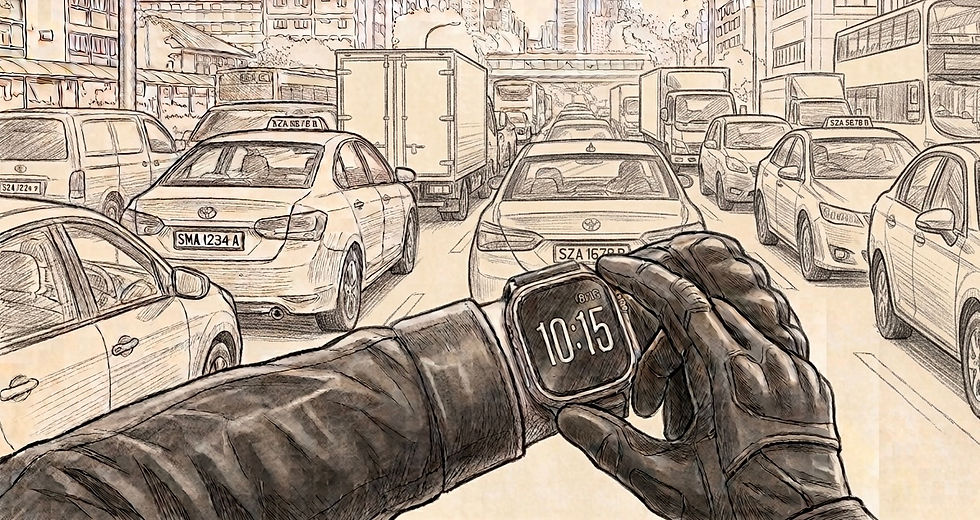
You can feel it the moment peak hour hits. It’s in the aggressive tailgating, the drivers cutting lanes without signalling, and the sudden, petty escalations. We usually call it 'road rage' and blame it on bad traffic or poor driving etiquette.
But the road doesn't create this anger. The road has simply become a societal punching bag.
I recently experienced this firsthand. A driver was tailgating me aggressively. My initial instinct was to be empathetic. I figured he was in a rush or dealing with an emergency. We've all been there, so I looked for a safe opening to let him pass.
But the moment he overtook me, his behaviour changed.
He didn't speed off. Instead, he slammed his brakes violently right in front of my motorcycle. For the next few kilometres, he stayed ahead while deliberately weaving, slowing down, and accelerating as I tried to safely avoid him. He even wound down his window to yell at me while driving right beside me, actively bullying me on the road.
In a split second, my sympathy evaporated. It had to.
Inside a car, people feel anonymous. Shielded by tinted glass and speed, their societal filters drop, and their true colours come out. The road becomes the place where the pent-up frustration of a high-pressure lifestyle finally spills over.
But it doesn't stop there. This same unvented pressure leaks into our homes, our retail spaces, and our offices. When people are running on absolute empty, they start treating the world around them as a target.
The Myth of the Corporate Partition
For years, corporate management has pushed the idea that employees can cleanly separate their professional lives from their personal ones. We are told to 'leave our problems at the door'.
But human psychology doesn't work in silos.
If a leader or an employee is operating in a workplace pressure cooker all day, struggling with constant, unsupported change, fear of failure, or burnout, that stress doesn't vanish at 6.00 pm. It sits in their nervous system. It follows them into the car, onto the PIE, and right through the front door of their home.
When a driver weaponises their vehicle to bully someone else, especially someone far more vulnerable on a motorcycle, we aren't just looking at a bad driver. We are looking at a systemic failure. We are looking at an individual whose mental wellness has completely ruptured under the weight of an unyielding lifestyle.
Why Change Management is a Wellness Imperative
This is exactly why, at Suku Consulting, I refuse to decouple Change Management from mental wellness.
If an organisation pushes through massive transformations without equipping its people with the psychological tools to handle the transition, it is contributing directly to this pressure cooker. Compliance might be achieved on paper, but you are breaking your human capital to get there.
Through our Resilience+ framework, we focus on managing these internal transitions before they turn into outward crises.
It's about teaching teams to Recharge before they hit a boiling point, giving them the mental toughness to Refocus on the next safe move when a project goes sideways, and ensuring they Reconnect as an ensemble rather than treating colleagues as obstacles in their way.
The Mirror on the Windscreen
How we behave when we think we are invisible is the ultimate mirror of our mental well-being.
If our workplaces, our roads, and our communities are becoming increasingly volatile, the solution isn't more rules, heavier fines, or tighter metrics. Structural compliance doesn't cure cultural unhappiness.
The solution is a conscious commitment to building human resilience.
At Suku, my mission goes beyond the boardroom. By helping organisations navigate change with empathy and structured psychological care, we build leaders who don't just succeed at work; but who show up as calmer, safer, and more present human beings on the journey home.
Are you driving your organisation with a rigid script, or are you actually equipped to handle the unexpected twists in the road?
Let’s talk about building a culture that stays calm under pressure.


Comments