The Cost of Fear: Why Public Shaming is an Operational Failure, Not a Management Style

Updated: May 20
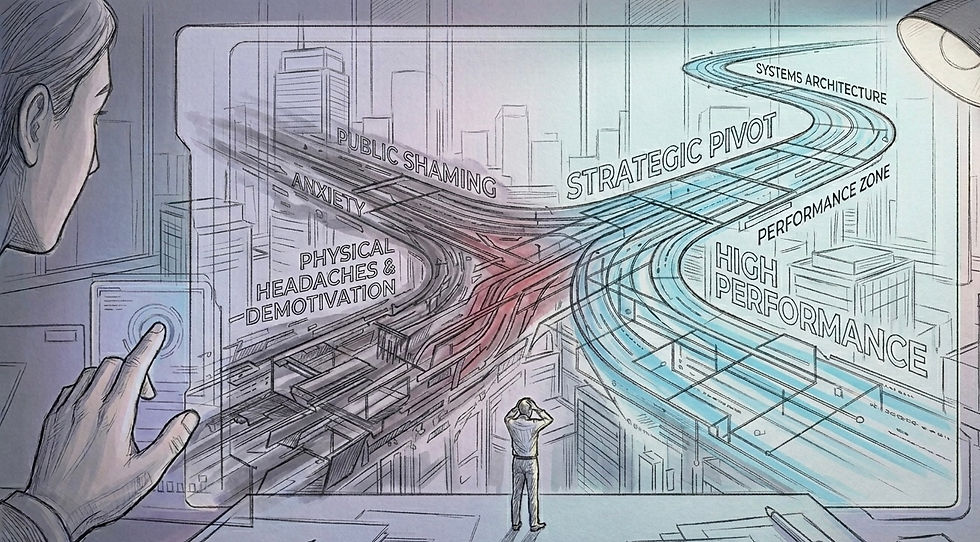
Spend over fifteen years in change management, and you will see the same boardroom conversations repeat themselves. We map out workflows, audit supply chains, and debate tech stacks. But we rarely talk about the invisible friction that quietly breaks them: fear.
I recently watched the internal dynamics of a small, fast-paced operational business. To anyone walking in off the street, it looked like a high-pressure environment getting things done. But look closer, and the primary management tool was daily, public scolding. If an administrative detail went missing or a workflow bottle-necked, the response wasn't a process review; it was public humiliation.
Some people dismiss this as 'old-school accountability' or a necessary evil in a demanding sector. It isn't. Relying on volume and intimidation is never a management style; it is an admission that your systems are broken.
When you strip away the corporate buzzwords, the data shows exactly what happens to a business when fear takes over the floor.
The Real 'Anxiety Zone'
Real operational excellence requires a basic baseline of psychological safety. Harvard Business School professor Amy Edmondson proved this decades ago: when people see their peers get publicly torn apart for a mistake, their brains go into basic survival mode.
To protect themselves from being the next target, employees do three things: they stop innovating, they withhold critical feedback, and they actively hide mistakes.
Fear doesn't drive quality. It just drives errors underground, turning a minor administrative hiccup into a ticking operational bomb. True high performance happens when teams can call out a system failure early, without worrying about being yelled at.
The Hidden Tax on Your Balance Sheet
Autocratic managers often pride themselves on running a 'tight ship', but they rarely look at what their turnover is costing them.
Hostile behavior is incredibly contagious. It drives stress up, tanking morale and triggering a constant cycle of resignations. In a small or highly specialised business, the cost of constantly recruiting, onboarding, and training temporary staff is a massive, unhedged drain on cash flow.
Even worse, the resulting instability ruins handovers, creates backlogs, and eventually hits the client experience. Toxicity is a measurable financial liability that directly eats into profitability.
Shouting is Just Bad Architecture
If a leader has to resort to emotional outbursts to keep an operation moving, it means their underlying infrastructure is failing.
In structural transformation, a recurring execution error is almost never an individual personnel flaw; it is a design flaw. Shouting at someone for a messy handover or a missed deadline usually means your onboarding is weak, your communication channels are fragmented, or your documentation is non-existent.
Exceptional leaders do not fix people with volume. They fix systems with strategy.
The Strategic Pivot
An organisation's culture isn't a soft HR luxury; it is a core operational asset. If a workplace environment leaves your team with physical stress, tension headaches, and chronic demotivation, you are operating at a fraction of your true capability.
At Suku Consulting, our philosophy is simple: Creativity is the Strategy. True agility needs breathing room. It requires clean, predictable feedback loops and robust workflows, not volatile outbursts.
Stepping away from an autocratic model doesn't mean lowering your standards. It means engineering a business rooted in structural strength, operational clarity, and mutual professional respect.
Recommended Reading
If you want to look at the hard metrics behind organisational behaviour, these are worth your time:
Psychological Safety and Learning Behaviour in Work Teams – Read the original landmark study by Professor Amy C. Edmondson on the Harvard Business School Faculty & Research Page.
Toxic Workers (Working Paper No. 16-057) – Review the full economic analysis of workplace toxicity and attrition costs by Michael Housman and Dylan Minor on the Harvard Business School Working Knowledge Platform.
The No Asshole Rule: Building a Civilised Workplace and Surviving One That Isn't – Explore the core tenets of Robert I. Sutton's workplace dynamics research outlined on The No Asshole Rule Wikipedia Overview.
Understand Team Effectiveness (Project Aristotle) – Review the extensive, data-driven frameworks on team dynamics compiled within the Google re:Work Guide on Team Effectiveness.



Comments